

KEY TAKEAWAYS
CONTENTS
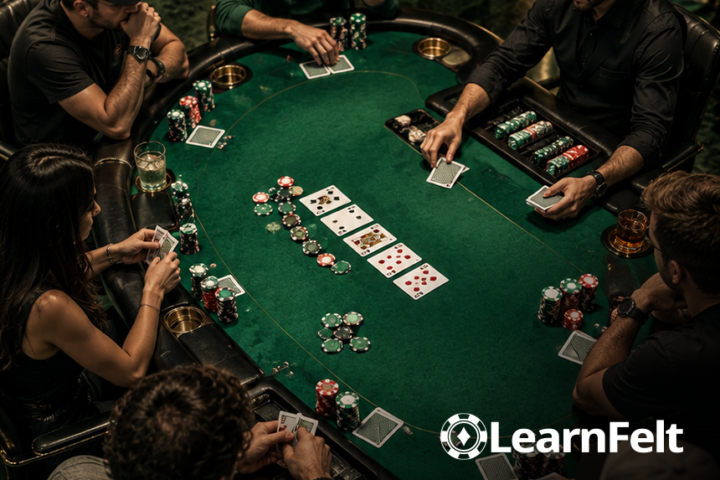
The turn and the river are the fourth and fifth community cards in Texas Hold’em, dealt face up in the middle of the table after the flop. The turn is the fourth card, and the river is the fifth and final one. Each card arrives with its own round of betting, and when the river betting finishes, the players still in the hand reach the showdown, where cards are shown and the winner is decided. Together, the flop, turn and river make up the board, the shared cards every player can use.
For a beginner, these last two streets are where a hand reaches its conclusion. After the river, no more cards come, and every player knows the best five-card hand available. This guide explains what happens on the turn and the river, how each betting round works, how a showdown is decided and which mistakes confuse newcomers. A short example hand with real cards shows how a single card can change who is winning.
What the Turn and the River Are
In Texas Hold’em, every player receives two private cards called hole cards, and five shared cards are dealt face up to form the board. The board arrives in three stages: three cards on the flop, one card on the turn and one card on the river. The turn is the fourth community card, and it is sometimes called fourth street.
The river is the fifth and final community card, also known as fifth street. The word “street” is simply poker language for a stage of the hand.
Before the flop, the turn and the river, the dealer removes the top card of the deck and discards it face down. This is the burn card, a security precaution that keeps the next card hidden from anyone who might have seen the back of the top card. Players never see it, and it takes no part in the hand.
The names “turn” and “river” are table slang that became standard, and their exact origins are not firmly documented. What matters for a beginner is the order: flop first, then turn, then river. After the river, each player has seven cards to choose from, the two hole cards plus the five board cards, and uses the best five of them.
How the Turn and River Betting Rounds Work
The turn round
When the flop betting round is finished and at least two players remain, the dealer burns a card and deals the turn. A new round of betting starts. The first active player to the left of the button acts first, then play moves clockwise, so the player on the dealer button acts last if still in the hand. If nobody has bet, a player may check (pass the action without betting) or bet. If someone has bet, the choices are fold, call or raise. The round ends when every player still in the hand has put the same amount into the pot, or when everyone else has folded.
The river round
The river works the same way. The dealer burns another card, deals the fifth board card and a final round of betting begins, again starting with the first active player to the button’s left. Nothing is dealt after this, so the river round is the last chance to bet in the hand.
How much you can bet
The size of bets depends on the betting structure. In no-limit games, a player may bet any amount from the minimum, usually the size of the big blind, up to all of their chips. In a standard fixed-limit game, bets and raises on the turn and river are the “big bet,” which is twice the size of the bets before the turn. The differences are laid out in limit vs. no-limit poker.
The showdown
If two or more players remain once the river betting is complete, the showdown takes place. In common practice, the last player to bet or raise shows first, and if nobody bet on the river, the first player to act shows first, though procedures vary by cardroom. The best five-card hand wins the pot, and identical hands split it. If everyone else folds at any point, the last player wins without showing cards. The earlier round is covered in what happens on the flop.
Example: How One Card Changes the Winner
Suppose two players, Ana and Ben, are still in the hand after the flop of J♦ 8♣ 3♥. Ana holds Q♥ Q♦, a pair of queens. Ben holds A♠ J♠, a pair of jacks with an ace as the extra card, called a kicker. Ana is ahead, because queens beat jacks.
The dealer burns a card and deals the turn: 3♠. The board is now J♦ 8♣ 3♥ 3♠. Ana has two pair, queens and threes. Ben also has two pair, jacks and threes. Ana is still ahead, since her top pair is higher. Ana bets and Ben calls.
The dealer burns another card and deals the river: A♣. The final board is J♦ 8♣ 3♥ 3♠ A♣. Ben now has two pair, aces and jacks, with an 8 as the fifth card. Ana has two pair, queens and threes, with the ace on the board as her fifth card. Both players check, and at the showdown Ben’s aces beat Ana’s queens, so he wins the pot. One card on the river changed the result.
How to Read the Board on the Turn and River
With four or five board cards showing, each player finds the best five-card hand by combining hole cards with the board. A simple habit is to name your hand to yourself each time a card arrives, such as “pair of queens” or “two pair.” The ranking of every hand is in poker hands ranked from best to worst.
The board also shows what other hands are possible. A board with a pair, such as two threes, means a player could hold three of a kind or a full house. Three cards of one suit mean a flush is possible, and cards close together in rank mean a straight is possible. Knowing this does not tell a player what opponents hold. It only explains why a hand that looked strong on the flop may be beaten by the river.
Finally, the board can play by itself. If the five shared cards make the best hand available, every player still in can use them, and the pot is split among those who share the best five cards.
Common Beginner Mistakes on the Turn and River
The first mistake is thinking both hole cards must be used. In Texas Hold’em, a player may use two, one or none of the hole cards, whichever gives the best five-card hand. The rule of using exactly two belongs to Omaha.
Another mistake is assuming the best hand on the turn stays the best hand. The example above shows why it does not. One more card can lift another player’s hand, so a river can reverse the result.
Beginners also act before the dealer has finished. Waiting for the card to be dealt and for the earlier player to act is part of good table habits, and acting out of turn can cause confusion. A third error is believing a showdown always happens. If every other player folds, the last player wins immediately and does not have to show a hand.
Where the Turn and River Appear in Real Games
In a casino or cardroom, the dealer burns and deals each card, often announcing the turn or the river aloud. In a home game, whoever is dealing follows the same steps, and the burn card is sometimes skipped by friendly agreement. Online, the software deals and displays the turn and river automatically, and a clock limits how long each player has to act.
The turn and river are also where much of the money goes in, because betting on later streets is often larger. Before playing for real money, a beginner should set a budget in advance, remember that short-term results involve luck, and check the legal age and rules for real-money poker, which differ by state and venue.
What to Learn After the Turn and River
The turn and river complete the board, and the next step is to see the whole hand in order. How to play Texas Hold’em, step by step connects the blinds, the hole cards, the flop, the turn, the river and the showdown in one walkthrough. For the stage just before these two cards, what happens on the flop explains how the board first appears.
Frequently Asked Questions